use cases

Knowledge Graph Use Cases

See how our solutions are powering data in a variety of industries.

Exploring Knowledge Graph Use Cases

Organizations use knowledge graphs when they need answers that live in different systems, teams, and domains. These knowledge graph use cases show how a connected foundation changes the way enterprises work – from the questions they ask to the speed of their actions.

Analytics Modernization

Analytics come to a halt when data lives in dozens of systems that weren’t designed to work together. Each new question becomes another request to data engineering. A knowledge graph cuts through that. Analysts follow connections. They can trace a trend back to its causes and ask deeper questions. Insights keep pace with the business.

Now analysts don’t have to wait for a new pipeline every time the business asks a different question. They can move around the data in a way that mirrors how the work happens. That speeds things up and makes it easier to explain what’s driving a trend or pattern.

Learn More

Data Fabric

Data fabric initiatives can be time-intensive. Every new source requires rework. With a knowledge graph, the semantic layer becomes the fabric. Stardog links SQL, NoSQL, and unstructured sources where they already live. Teams keep the flexibility of their existing tools, but gain a shared understanding of what the data means. Integration is lightweight.

Because the meaning sits in one place, updates to downstream systems don’t undo months of work. Teams can bring on a new tool or dataset without starting over, which keeps long-running fabric initiatives from stalling out.

Learn More

Data Lake Acceleration

SQL data lakes/warehouses collect everything, but don’t explain anything. Adding a knowledge graph brings structure. Relationships reveal which datasets matter and where they originated. People can find the right tables with faster query times and trust what they’re pulling into models. 

They can see which tables connect, what each one describes, and how the data got there. That makes it easier to choose the right inputs for analysis or modeling without a lot of back-and-forth validation.

Learn More

Drug Discovery

Life sciences teams look at experiments, pathways, targets, compounds, and clinical evidence. Each dataset is formatted differently. Each lab uses its own terminology and stitching everything together slows research down. A knowledge graph gives scientific data shared meaning. And promising directions stand out earlier in the process.

Boehringer Ingelheim recognized the need to connect data from disparate parts of the company to increase research and operational efficiency, increase output, and ultimately accelerate drug research. Using Stardog to build an enterprise knowledge graph has allowed bioinformaticians and analysts to quickly and easily access the full body of institutional knowledge, all while providing cost savings.

Learn More

Operational Risk

Operational risk is a relationship problem. Events, controls, policies, systems, vendors, and people all influence each other. But the data behind them lives on separate platforms. A knowledge graph brings these elements into one picture. Risk teams can follow dependencies in different business units. They work from a model that aligns with how the organization operates.

It’s easier to understand the chain of events when something goes wrong. A vendor issue, for example, doesn’t stop at just a vendor issue. You can see where it reaches and who depends on it. That visibility helps teams prioritize what to look at first.

Learn More

Supply Chain

Supply chains cross multiple systems. No single platform shows all the moving parts that go into network management. When something changes, teams only see a fraction of the impact. With a knowledge graph, those connections are visible. They can model “what if” scenarios and spot bottlenecks before they slow production.

When something shifts, like a quality issue or a production change, teams can trace where it lands and find ways to fix it. This also helps uncover patterns that would otherwise stay hidden in individual systems.

Learn More

Enterprise Knowledge Graph Use Cases by Industry

Every industry deals with disconnected systems, but the consequences look different depending on the work. Regulations tighten. Risk multiplies. Knowledge graphs give each industry a connected foundation grounded in how their world operates. Read on to explore some individual knowledge graph use cases by industry.

  • Financial Services & Banking

  • Government Agencies

  • Life Sciences

  • Manufacturing

  • Financial Services and Banking

    Financial institutions manage sensitive data relationships in business: accounts, transactions, and exposures, instruments, and jurisdictions. Compliance teams search for evidence buried in disconnected systems. Fraud analysts chase patterns they don’t have visibility into. A knowledge graph ties these pieces together. Banks can follow money flows through networks of entities and map exposures. Customer and transaction data become part of one connected model.

    Learn More
  • Government Agencies

    Government agencies operate in environments where mission systems rarely align. Analysts know the information exists, but they can’t follow it. Policy teams struggle to tie rules to the systems and activities that prove compliance. A knowledge graph makes those connections visible. Agencies can track entities and understand how events relate. Context is discoverable, and decisions are more reliable.

    Learn More
  • Life Sciences

    Drug development is one long chain of relationships. The data behind it lives in labs, medical imaging, formats, and functions. A knowledge graph brings scientific meaning into one model. This way, research reflects the interconnected nature of the science itself.

    Learn More
  • Manufacturing

    Manufacturers depend on visibility. When a part fails or a supplier falls behind, teams scramble to understand the downstream impact. A knowledge graph connects the parts. Engineers can trace how a design change affects assemblies. Supply teams can identify shared risks across suppliers. Operations teams can see how conditions on the factory floor tie back to product performance in the market. That creates a more resilient supply chain.

    Learn More

Why Knowledge Graphs Are the Solution to Enterprise Data Issues

Enterprise data problems rarely come from a lack of information. They come from the distance between that information. Think: systems that don’t align, definitions that don’t match, and relationships that stay hidden. Knowledge graphs close those gaps by making interconnected data a reality. They give organizations a way to see how everything fits together, even when the systems behind it don’t.

A knowledge graph, with its ability to make real-world context machine-understandable, is the ideal tool for enterprise data integration. Instead of integrating data by combining tables, data is unified using a graph’s ability to endlessly link concepts without changing the underlying data. Data unification connects data silos and produces a flexible data layer for the enterprise.

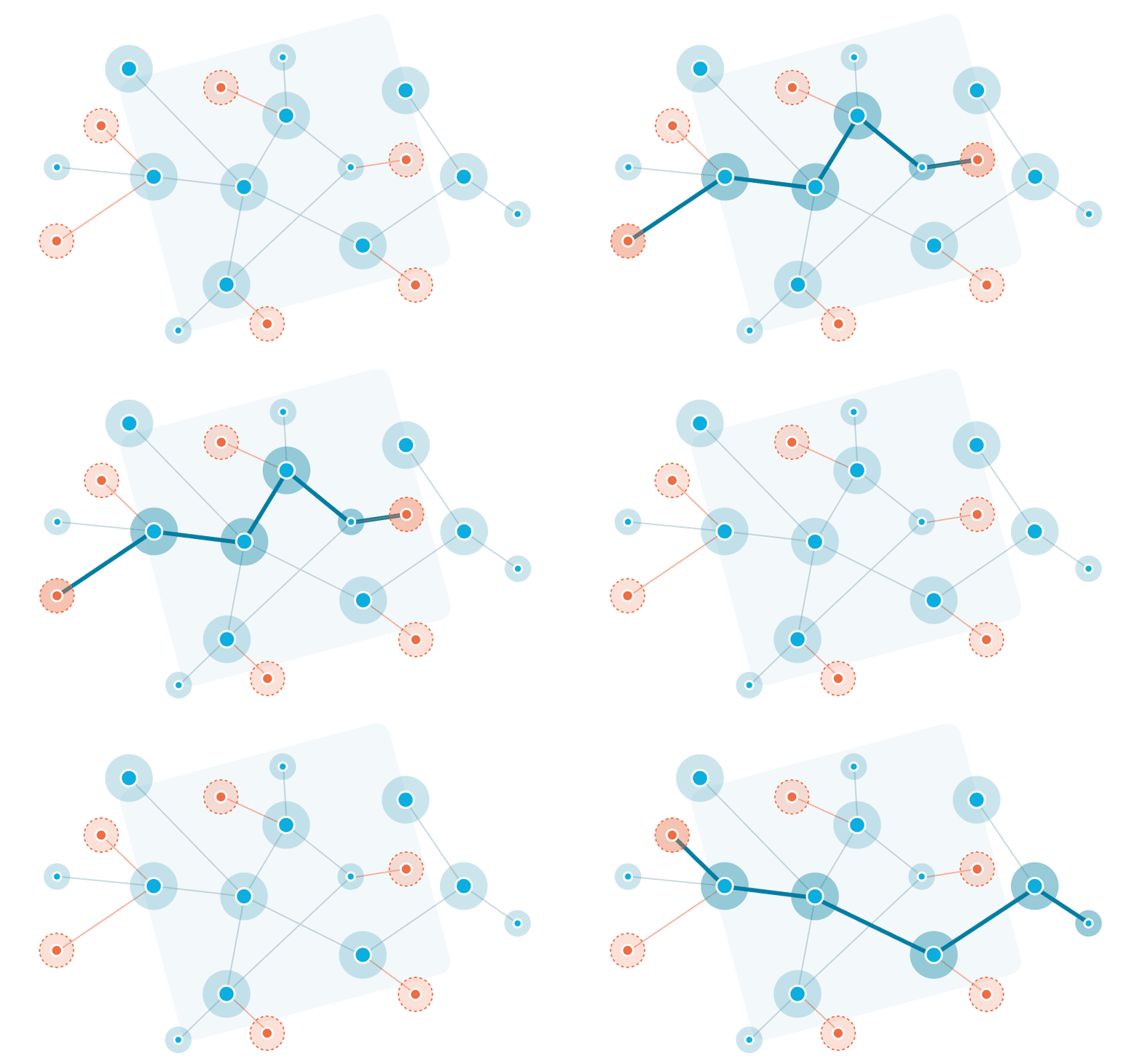
Knowledge graph tracing information

How Knowledge Graphs Bring Everything Together

Enterprise data is the world’s most strategic asset going forward, while on the ground, it’s painful, diverse, heterogeneous, and distributed. A knowledge graph is the only realistic way to manage enterprise data in full generality, at scale, in a world where connectedness is everything.

Traditional integration tries to pull everything into a single structure, but that only works until something changes. Knowledge graphs make integration flexible. They link sources where they already live for a connected view of the truth.

Based on Graph image

Knowledge Graphs Restore Context

Disconnected systems force analysts to answer questions with partial information. They only see the symptoms. They can tell you what happened, but not why. Knowledge graphs reintroduce context by showing how data points relate.

A spike in complaints ties back to a product version. A financial risk ties back to specific transactions. With relationships modeled directly in the data, teams get explanations. They’re not stuck with isolated facts.

implemented ontology

Knowledge Graphs Adapt

Relational databases work when the world stands still, but enterprises add new tools and rules constantly. Each change forces a redesign or a cleanup project. Knowledge graphs handle change naturally. New entities and relationships fit into the model without breaking what already works. As the business evolves, the graph evolves with it.

There’s always more data — new external data streams, new data sources needed for the next release, new acquisitions with their own messes of data. Stardog’s enterprise knowledge graph platform easily incorporates new sources while maintaining original schemas and metadata.

Limitless Image

Knowledge Graphs Capture Meaning

Rows and columns in traditional databases store facts. What they can’t store is how those facts relate in real life. A “customer” means one thing in sales, another in support, and something different in finance. Knowledge graphs use ontologies to get to common ground. Everyone works from the same vocabulary.

AI systems struggle when context is missing. They hallucinate. They misinterpret terms. A knowledge graph grounds AI in real relationships and verified facts. Knowledge graph applications bring structure to language models.

Getting Started With Enterprise Knowledge Graphs

It can be hard to know where to begin with knowledge graphs if you’re new to the concept or don’t have a grasp on the right approach. But getting the ball rolling is easier than you might think.

You don’t have to overhaul your data ecosystem to get value from a knowledge graph. You can begin with a single problem that’s too hard to solve in your current systems. Then, connect a few key sources and expand once the value becomes obvious. The goal isn’t to rebuild your stack. You want to reveal the connections your business already depends on.

01

Start With a High-Value Question

The best knowledge graph projects begin with a question that matters to the business but is nearly impossible to answer today.

Questions like:

  • Which factors really drive churn?

  • How is a supplier delay going to affect downstream production?

  • Where is the evidence behind this regulatory decision?

These questions show you where context breaks down. Mismatched definitions or missing relationships make the answers hard to find. They also define the first set of entities you need to bring together. Avoid starting with a massive modeling effort and get clarity about the decision you’re trying to improve.

02

Define the Concepts That Matter Most

At this point, you can dig a little deeper to understand what data you should bring together. You only need the shared concepts tied to your first question: customers, products, suppliers, assets, trials, claims, or any other entities at the center of your analysis. These are the building blocks of your first ontology.

You are aiming to understand how all these categories, types, things, and objects relate to each other and what information is out there to describe them even more accurately. This is the “conceptual model.” And in a semantic knowledge graph like Stardog, it’s represented by a schema or ontology.

03

Connect a Few Sources

You may think you need every system integrated before you can start. You don’t.  A small set of sources is enough to demonstrate value:

  • CRM for customer details
  • ERP for orders and products
  • Data lake for behavioral signals
  • Case management or quality system for events

Stardog connects them virtually, without copying or reshaping data. You can query systems even when they live in different formats and locations. That first connected view shows why relationships matter. It also builds momentum for expanding the graph.

04

Let Insights Drive Expansion

Knowledge graph projects may not stay confined to their original scope, and that’s a good thing. For example: 

  • A churn analysis leads to customer experience work.
  • A supply bottleneck turns into supplier risk modeling.
  • A clinical question expands into evidence linking and trial optimization.

Because the model adapts easily, teams can add new rules and data sources as the business grows. The graph scales. You don’t have to rebuild pipelines or replatform systems just to ask new questions.

05

Choose a Platform Purpose-Built for the Enterprise

Simple relational databases aren’t enough in several cases. Enterprise knowledge graphs require:

  • Access to any source including SQL, NoSQL, documents, logs, and streams
  • Virtualization so data stays where it is, always up to date
  • Ontologies and semantics to align meaning
  • Inference to surface facts that aren’t explicitly stored
  • Security and governance so access respects rules and roles
  • Scale to billions of relationships

Stardog brings these capabilities together so teams can focus on insights. You get a connected, governed foundation that grows with your organization. All starting with the first question and expanding from there.

Knowledge Graph FAQs

Knowledge graphs are used anywhere context matters and data lives in many systems. Common use cases include analytics modernization, data fabric projects, supply chain visibility, fraud detection, risk management, drug discovery, customer 360, and GenAI search. They help teams follow relationships across sources so answers reflect the full picture.

A knowledge graph connects data through meaning. It shows how people, products, systems, events, or concepts relate. This is true even when the underlying systems don’t. The purpose is to turn scattered information into usable knowledge. Analytics, decisions, and AI all operate with context.

They bring context to data. This makes trends easier to explain and insights faster to uncover. Teams can ask more complex questions and act sooner. All without waiting for new pipelines or reshaped datasets.

Financial services, government, life sciences, and manufacturing rely on knowledge graphs. These industries have strict regulations and data relationships. Knowledge graphs give them a connected, governed view of information.

LLMs guess when context is missing, so they lose factual accuracy. A knowledge graph supplies that context. It gives AI a structured source of truth so answers are based on relationships. The model can check the graph before responding, which keeps output more reliable.

If you’re struggling to answer questions or build new pipelines for every new analysis, a knowledge graph helps. It’s also a fit if AI output feels untrustworthy or if decisions rely on data that never appears in one place. The signs often show up as slow insights and repeated rework.

Learn More

Download our e-guide to learn more about Knowledge Graphs and how they differ from other data management technologies.